Project leaders
The project is jointly promoted by the Maritime and Port Authority of Singapore (MPA) and PSA Corporation / PSA Singapore. MPA is Singapore’s maritime and port authority, responsible for regulating, developing and promoting innovation within the country’s maritime ecosystem. PSAC is the port operator that manages key terminals in Singapore, mainly Pasir Panjang Terminals and Tuas Port.
Project description
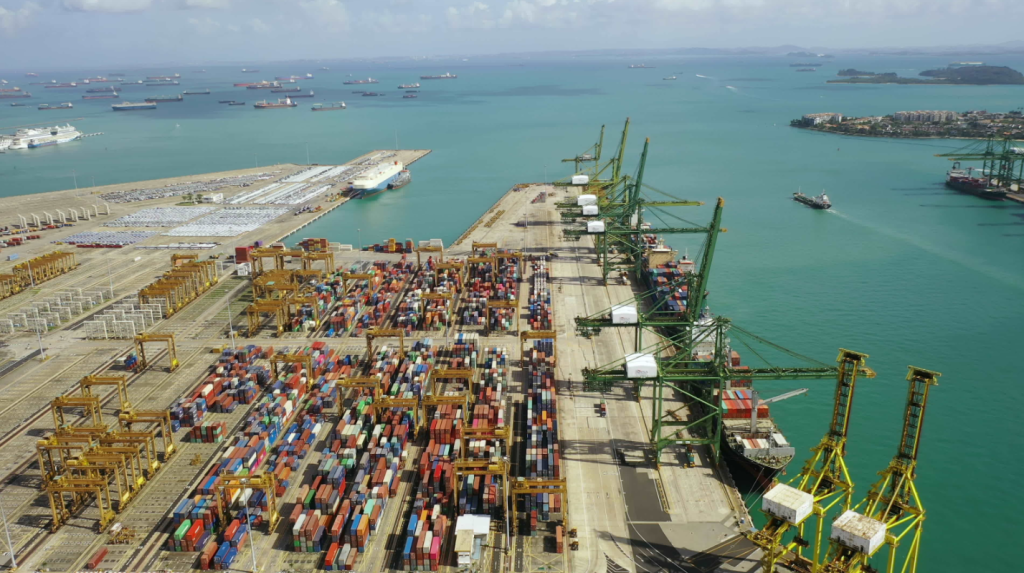
MPA and PSAC have agreed to design and develop an Autonomous Inter-Gateway Feeder (aIGF), an autonomous feeder vessel powered by zero-emission fuels and intended to transport containers between port terminals. The initiative addresses a specific operational challenge: PSAC’s terminals in Singapore are distributed across different geographical areas and require Inter-Gateway Transfer (IGT) movements to ensure the smooth connection of containers between facilities. These transfers are currently carried out by road or by sea using conventional feeder vessels.
The project proposes an autonomous alternative to improve internal port connectivity, reduce dependence on crewed vessels and road transport, and move towards more efficient, digital and sustainable port operations. The aIGF is conceived as a technology capable of operating between terminals with minimal human intervention, in a complex and highly intensive maritime environment such as the Port of Singapore.
The case is particularly relevant because it combines maritime automation, integration with port systems and the energy transition. It is not only about developing an autonomous vessel, but also about validating a complete operational model for cargo movement between terminals, including container handling systems, integration protocols with existing infrastructure and safety requirements for operating in real port environments.
The project is part of Singapore’s strategy to become a global port capable of managing autonomous or remotely operated ocean-going vessels and harbour craft. This vision includes the creation of a regulatory environment prepared to support the safe deployment of these technologies, establishing standards and certification requirements for autonomous maritime transport.
Another key aspect is the environmental dimension. The vessel is expected to include a suitable energy and propulsion system, either fully electric or compatible with net-zero fuels such as methanol, ammonia, hydrogen or biofuels. In the case of biofuels, the proposal must be compatible with B100, a fuel composed of 100% pure biodiesel.
Project objectives
The objectives of the project are to establish autonomous vessel operations and cargo handling systems suitable for port environments, as well as to develop integration protocols with existing port infrastructure and systems. The initiative also seeks to demonstrate that these autonomous operations can be carried out safely and efficiently in complex maritime environments. In addition, the project aims to design and develop suitable energy and propulsion systems, either fully electric or compatible with net-zero fuels from 2030 onwards.
Publication date
28 May 2026
Useful links
- MPA Expression of Interest to design and develop an Autonomous Inter-Gateway Feeder
- MPA and PSA Singapore press release on the call for autonomous shipping proposals
- MarineLink article: MPA and PSA Singapore invite proposals for autonomous container feeder vessel solutions
- AsiaOne article: MPA and PSA Singapore seek proposals for autonomous feeder vessels