Project leaders
The project is led by Beecharge Innovation Group Pte Ltd, a Singapore-based company specialized in mobile, on-demand electric charging solutions. Beecharge is part of the maritime innovation ecosystem PIER71™, a leading port and maritime innovation hub supported by the Maritime and Port Authority of Singapore, focused on accelerating technologies related to the energy transition and port digitalization.
Project description
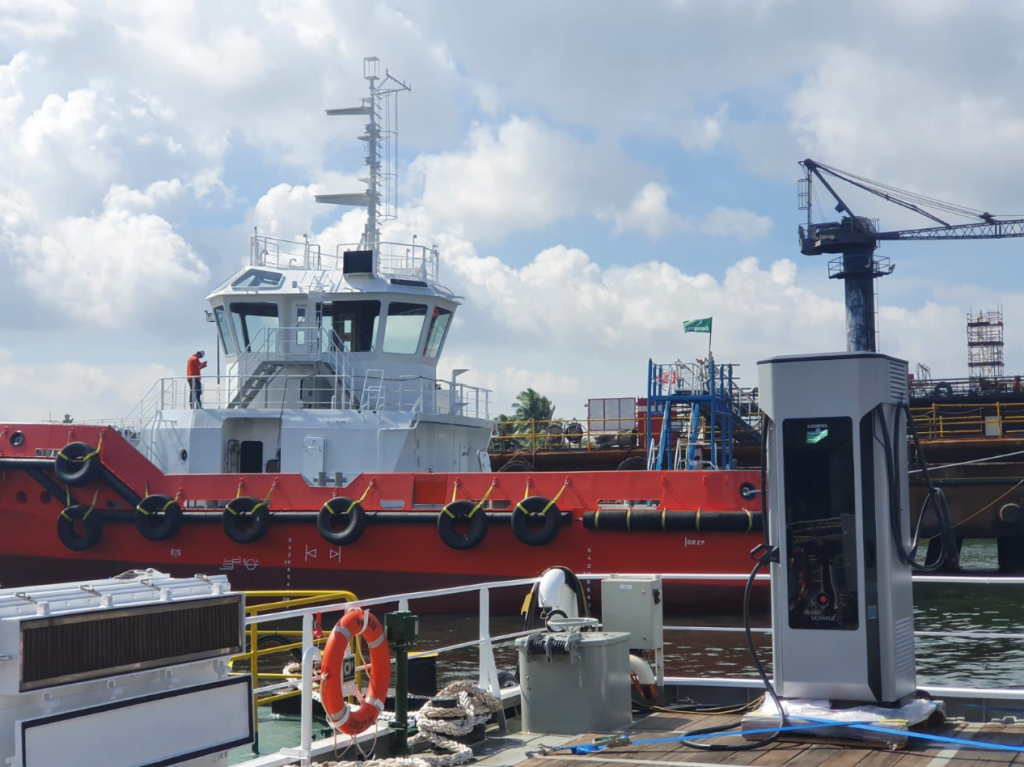
The company develops innovative mobile and autonomous electric charging solutions for electrified fleets and port vessels, addressing one of the main bottlenecks of the energy transition: the slow and costly deployment of fixed charging infrastructure. Its approach makes it possible to deliver energy exactly where it is needed, avoiding reliance on rigid infrastructure and reducing charging-related downtime.
The charging units operate off-grid and are powered exclusively by renewable energy, primarily solar, combined with integrated energy storage systems. This approach enables electricity supply without permanent grid connections, civil works, or grid capacity upgrades, which is particularly relevant in consolidated port environments, high-density logistics terminals, or remote locations.
A key differentiating element of the solution is its predictive dispatch system, which uses operational data and predictive models to anticipate fleet energy needs. Based on this information, the system intelligently decides when and where to deploy mobile charging units, ensuring operational continuity, reducing downtime caused by energy shortages, and optimizing the use of available resources.
The solution is already being deployed in environments such as the Port of Singapore, one of the world’s most congested and technologically advanced ports, validating its applicability in high-demand operational contexts. The technology can serve both electrified or hybrid port vessels, including tugboats, service vessels, and barges, as well as electric vehicles operating within the port area.
Through this approach, the startup offers a flexible and scalable alternative that supports the progressive electrification of ports and contributes to emissions reduction without requiring large upfront investments in fixed infrastructure.
Objectives
The project aims to facilitate electrification and emissions reduction in port environments through mobile charging solutions that reduce reliance on traditional fixed infrastructure. It seeks to demonstrate that reliable, renewable, and intelligent energy supply can be achieved without lengthy civil works or complex grid upgrades.
At the same time, the initiative aims to improve port operational efficiency, reduce downtime caused by energy shortages, minimize the required initial investment, and enable a progressive energy transition adapted to the specific conditions of each port environment. With this approach, the project contributes to the evolution of the port energy model towards more flexible, digital, and service-oriented solutions, aligned with the principles of smart ports and the blue economy.
Publication date
December 18, 2025
Useful links