Project stakeholders
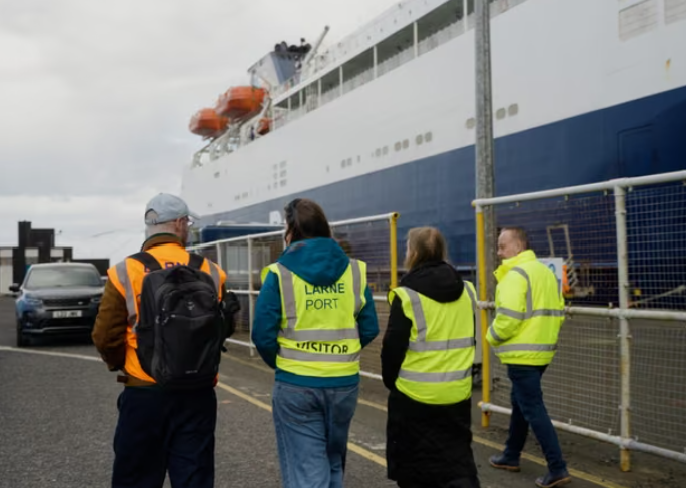
The project is driven by Larne Harbour, in Northern Ireland, in collaboration with Helix8, a company specialised in digital solutions based on digital twins, data and artificial intelligence applied to industrial and port environments.
Project description
This innovative project has developed an operational digital twin aimed at the decarbonisation of Larne Harbour, a regional port located in Northern Ireland. The initiative explores how advanced digital tools can help small and medium-sized ports, which do not necessarily have the same resources to invest in large digital infrastructures, monitor their emissions and define investment plans to reduce them.
The system combines a 3D model of the port updated in real time, a network of LoRaWAN sensors (Low Power Wide Area Network, a technology used to connect sensors and transmit data over long distances), environmental sensors and cameras with artificial intelligence to monitor vehicle activity, a cloud-based data infrastructure and a planning tool that transforms measured emissions into a prioritised list of decarbonisation actions.
The solution provides an up-to-date digital representation of port activity and links operational data with the emissions generated. This information facilitates the identification of the main sources of emissions and helps determine which actions can have the greatest impact within the decarbonisation strategy.
One of the project’s differentiating elements is that it combines monitoring, digital twin and investment planning in a single solution adapted to the needs and capabilities of a small or medium-sized port. Unlike large port digital twins, which are generally associated with highly complex infrastructures and significant investment, this proposal seeks to demonstrate how these technologies can be adapted to ports with different needs and operational scales.
The project has enabled the development of a verified inventory of 47 tonnes of annualised CO₂ equivalent emissions, based on real data measured during May 2026. This calculation follows the recognised methodologies of the GHG Protocol and the ISO 14064-1 standard for the quantification and verification of greenhouse gas emissions.
This case shows how digital twins can become tools to support environmental decision-making, enabling different types of ports to advance in emissions monitoring and in planning data-driven decarbonisation measures.
Project objectives
The main objective is to develop an accessible digital tool that enables Larne Harbour to measure its emissions, understand the main factors generating them and define investment priorities to advance decarbonisation.
The project also aims to demonstrate that digital twins and data-based monitoring and planning tools can be an affordable investment for small and medium-sized ports.
Publication date
06 October 2026