Project lead
Port of Antwerp-Bruges, in collaboration with its Digital Transformation Department and several companies specialized in laser sensor (LiDAR) technology and port automation.
Project description
At the end of 2020, the Port of Antwerp-Bruges launched the Smart Docking Innovation Challenge to find a solution to the issue of undesired vessel movements while moored — caused by passing ships or weather conditions such as wind or currents.
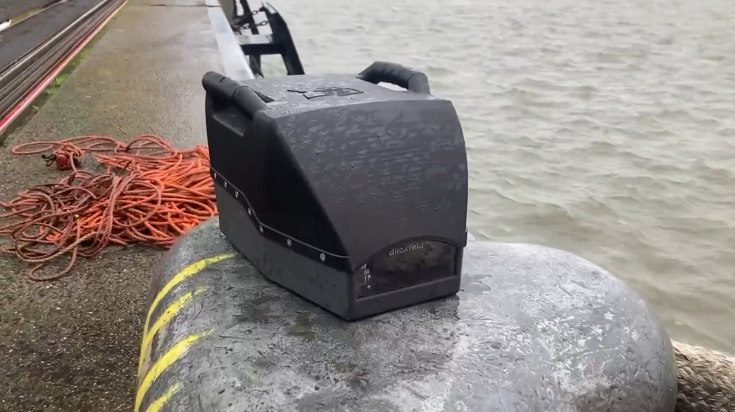
As a result of this challenge, an innovative device based on LiDAR laser technology has been developed and is currently being tested. It can measure the longitudinal and lateral movements of vessels with millimetre accuracy in real time, allowing even the smallest displacements to be detected.
The measuring device emits a laser beam that reflects off the ship’s hull. By measuring the time it takes for the beam to return, the system continuously calculates the exact distance to the vessel. This allows for precise detection of relative movement. When a displacement greater than one metre is detected, a safety protocol is triggered and port personnel are sent to verify the mooring conditions and ensure the ship’s safety.
Unlike traditional GPS-based systems, which required bulky backpacks and a time-consuming setup with frequent signal loss, the new LiDAR solution is installed directly on the quay and transmits information in real time to port staff via a digital platform. This enables continuous monitoring and a rapid response to any irregularities.
This solution is part of the Smart Docking concept and represents a key advancement in the digitalisation of port operations.
Project objectives
The main goal of this technology is to improve safety, efficiency, and precision during berthing manoeuvres, as well as enhance the monitoring and stability of vessels already moored at the quay. It also aims to reduce the risk of accidents and damage to infrastructure and ships.
Publication Date
June 13, 2025