Project Leaders
The project is led by the Hangzhou Railway Logistics Center, a public logistics hub under the China Railway Shanghai Bureau Group, specializing in terminal management and freight transport. The state-owned company Zhejiang Seaport Yiwu Hub Port Co., Ltd. is also involved, responsible for container terminal operations and port connections. The project also receives institutional support from the government of Zhejiang Province.
Project Description
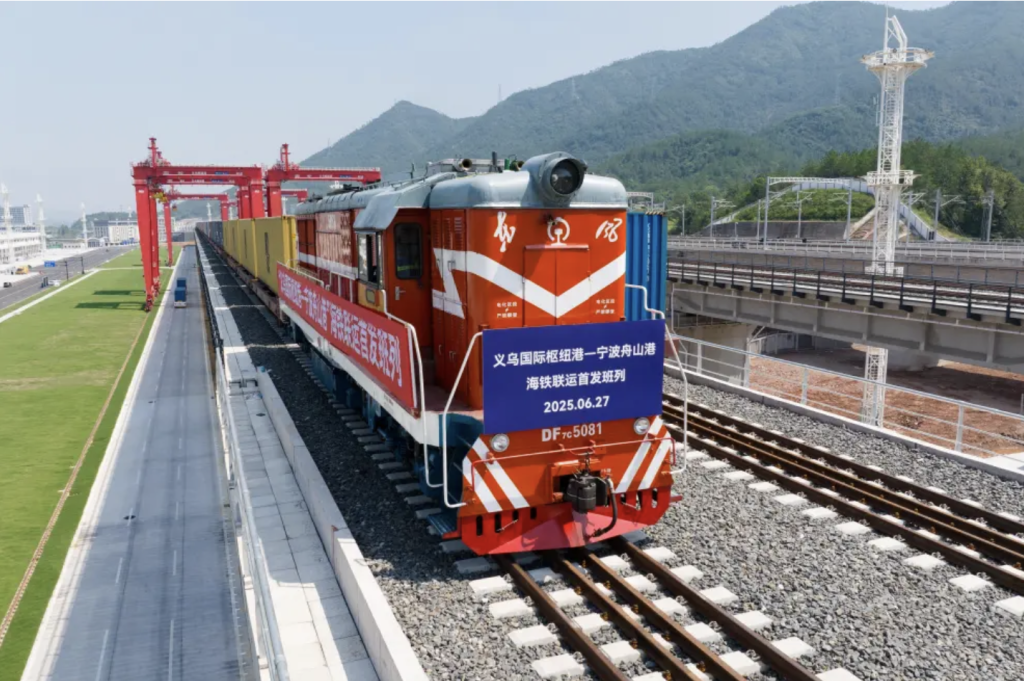
The Suxi container railway terminal, located within the Yiwu International Hub Port in China’s Zhejiang Province, began operations on June 27, 2025. This pioneering facility is the first in China to combine mixed autonomous operation capabilities, integrating advanced automated systems with traditional manual processes within the same site. The terminal is directly connected to the Ningbo-Jinhua railway line and has an annual capacity of 660,000 TEUs (twenty-foot equivalent units).
The terminal’s digital management system includes a rail freight loading area, a container yard, and a customs supervision zone. The facility features remotely operated gantry cranes, automated storage systems, and next-generation conveyors that enable unmanned operations while still allowing manual workflows for operational flexibility. This hybrid model marks a significant advancement in the modernization of China’s logistics infrastructure, setting a new standard for autonomous operations on the country’s rail network.
A key feature is that goods arriving at the Suxi terminal are treated as if they had already reached the Chinese seaport of Ningbo-Zhoushan—the world’s busiest port by cargo volume—thanks to a unified declaration, inspection, and release process that streamlines and accelerates procedures. This logistics corridor efficiently connects the inland Yiwu region with the seaport, reducing transit times and associated costs.
Project Objectives
The main goal of this mixed autonomous railway terminal is to enhance the efficiency and sustainability of China’s logistics chain.
By integrating advanced technologies, the project aims to reduce transit times and operational costs by directly linking inland production centers with global seaports. At the same time, it promotes the digitalization and automation of logistics processes, improving operational capacity without increasing labor needs and reducing environmental impact through the use of low-emission energy and optimized workflows.
Finally, the terminal aims to establish a replicable model that can serve as a reference for future logistics infrastructures both in China and internationally, supporting the transition to smarter and more sustainable transport systems.
Publication Date
10 July 2025
Relevant Links