Project stakeholders
The Jilin-2 project, developed in China, has been jointly driven by CIMC Offshore Engineering Research Institute, China Forestry Group Corporation and Beijing Forestry University.
Project description
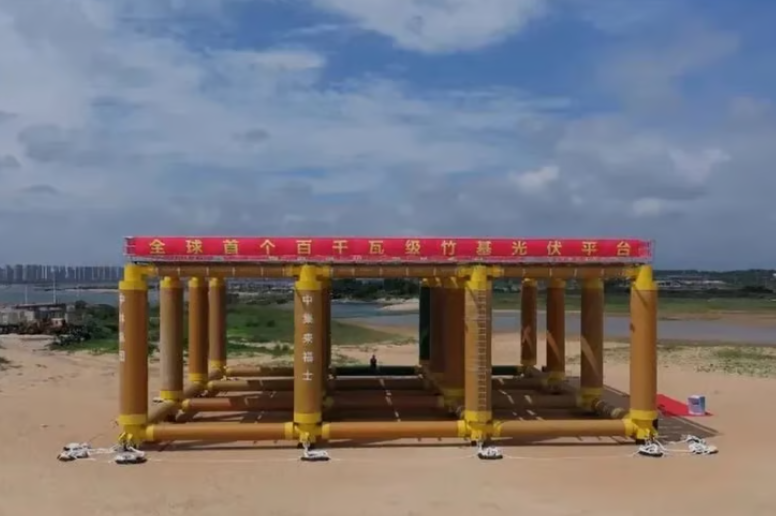
This innovative project develops a 100 kW offshore floating solar platform that incorporates a structure made of composite bamboo, replacing conventional materials such as steel or high-density polyethylene commonly used in this type of installation.
The Jilin-2 platform consists of composite bamboo tubes and pipes designed to operate in a marine environment, where infrastructures are exposed to factors such as corrosion, humidity, salinity, ultraviolet radiation and structural fatigue resulting from prolonged exposure.
The main innovation of the project lies in applying plant-based materials to an offshore infrastructure, an environment traditionally dominated by conventional materials such as steel and polymers. The proposal explores whether bamboo and wood composite materials can provide the necessary strength and durability properties for marine applications while reducing the environmental impact associated with traditional structures.
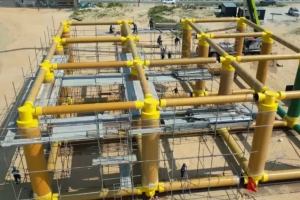
Jilin-2 uses third-generation “rolled bamboo” tubes together with a material called Marine Bamboo Tube, which the developers describe as a pre-stressed and fibre-reinforced wood and bamboo composite. The tubes provide buoyancy and structural support. Bamboo has been transformed into an engineering material suitable for modern applications. The fibres or strips are combined with resins and other components to create tube-like structures designed to be lightweight and strong.
The Jilin-2 platform represents an evolution from the Jilin-1 10 kW prototype developed in 2023, increasing capacity to 100 kW. The installation is part of an integrated demonstration project for the production of hydrogen, ammonia and methanol, in which renewable generation forms part of a broader energy system.
During the deployment of the platform, the behaviour of the structure under real marine conditions will be monitored, analysing aspects such as material strength, response to corrosion and long-term durability. This phase will provide knowledge about the feasibility of using bamboo composite materials in future marine applications.
This case is an example of how materials innovation can complement the development of new marine renewable energy infrastructures, exploring alternatives to conventional materials to advance towards potentially more sustainable solutions in offshore environments.
Project objectives
The main objective of the project is to demonstrate the potential of bamboo composite materials for the construction of offshore floating solar platforms, evaluating their behaviour under real marine conditions.
The initiative aims to generate knowledge about the strength, durability and applicability of these materials in marine infrastructures, as well as explore alternatives to traditional materials used in floating renewable energy structures.
Publication date
29 September 2026