Project leaders
The project is led by Rocsys, in collaboration with International Transportation Service (ITS), a terminal operator at the Port of Long Beach, California, USA, and Taylor Machine Works, the manufacturer of the electric equipment used in the deployment. The system has been deployed and tested in a real operational environment within the port.
Project description
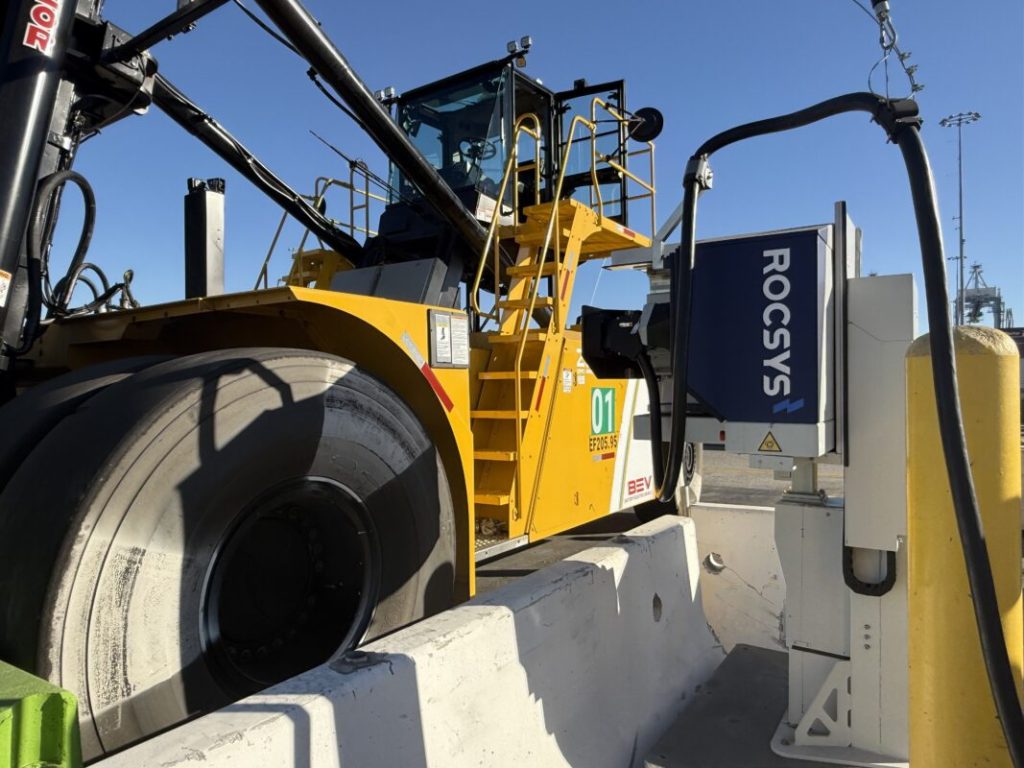
This case presents the deployment of a hands-free automated electric charging system for container-handling machinery at the Port of Long Beach.
The solution integrates an automatic connection device developed by Rocsys with an electric container handler, the Taylor ZLC-996 model. The system is not applied to the containers themselves, but to the equipment that handles them, which connects automatically to the charging point.
The system enables what is known as “opportunity charging”: short, frequent charging sessions carried out during natural pauses in operations, for example between work cycles, avoiding the need to stop the equipment for long periods for a full charge. In this case, the connection is made automatically through a system based on signal exchange between the vehicle and the charging point, without human intervention.
The initiative addresses one of the challenges associated with port electrification: making equipment charging compatible with intensive operational rhythms. Manual processes can introduce delays, safety risks and inefficiencies, especially when working with limited charging windows and highly utilised infrastructure.
The system is part of Rocsys’ platform and combines hardware, software and integration tools, including operational monitoring and API —Application Programming Interface— connectivity with terminal systems. The configuration is designed to enable repeatable charging cycles without human intervention and to support the scalability of electrification without significantly altering existing workflows.
This case shows how innovation in the electric charging process for equipment can act as an enabler of port electrification, not only through the adoption of electric equipment, but also through the automation of the processes that determine its operational use.
Automated electric charging for port machinery helps terminals electrify their equipment in order to meet zero-emission targets.
Project objectives
To deploy an automated charging system for electric port machinery, with the aim of improving operational efficiency, strengthening safety and facilitating the integration of electric equipment into terminals with intensive activity.
In addition, the project helps reduce the operational barriers associated with electrification, facilitating the adoption of electric equipment and supporting decarbonisation and zero-emission goals in the port sector.
Publication date
May 4th, 2026.