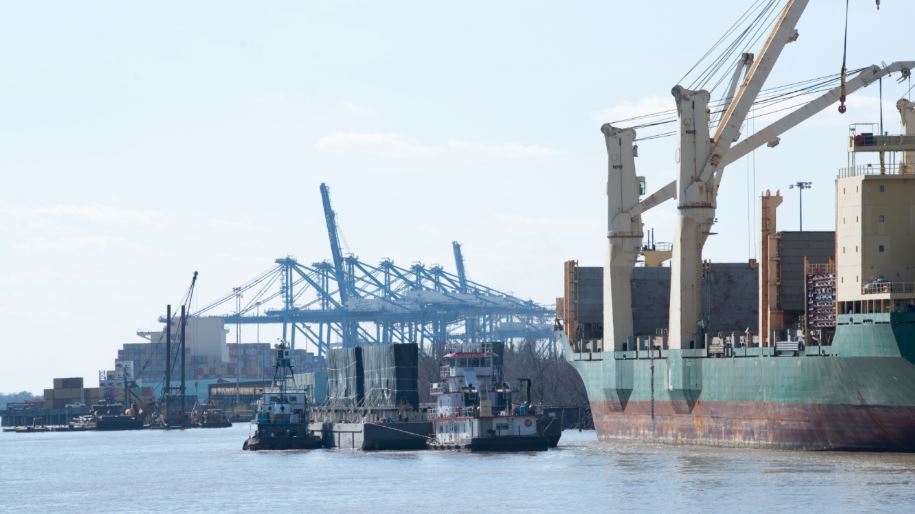
Project leaders
The project is being driven by the Port of New Orleans (Port NOLA), the New Orleans Public Belt Railroad (NOPB), and UTC Transoceanic, a joint venture established by the logistics companies Transoceanic and UTC Overseas.
Project description
Development of a digital platform based on artificial intelligence and a railway network digital twin to facilitate the planning of project cargo transportation, i.e., oversized, heavy-lift, or complex cargo that requires specialized logistics operations, such as large power transformers, wind turbine components, turbines, refinery equipment, industrial generators, and other large industrial structures.
Project cargo shipments, commonly associated with the energy, infrastructure, and heavy industry sectors, often arrive at the Port of New Orleans by sea and must continue their journey by rail, as transporting such cargo by road is frequently impractical due to its weight and dimensions. Planning rail transportation for these loads requires assessing constraints related to bridges, tunnels, loading gauges, track geometry, and other railway infrastructure limitations, a process that has traditionally taken weeks or even months.
To simplify this task, the project includes a customer-facing application that allows users to enter cargo dimensions, weight, and technical specifications into a digital platform capable of quickly determining whether the cargo can be transported through the rail network and recommending the most suitable routing options.
The platform is supported by a digital twin that continuously monitors the railway network in real time, integrating up-to-date information on infrastructure conditions, operational restrictions, and traffic conditions.
The initiative aims to provide logistics operators and cargo owners with greater visibility and planning capabilities, reducing the time required to assess alternatives and improving operational predictability.
This technology strengthens the Port of New Orleans’ position in the project cargo market, as logistics operators handling this type of cargo often select ports not only based on their on-dock capabilities but also on how efficiently cargo can be moved inland once it leaves the port.
Project cargo is a strategic segment for many ports. Thanks to its infrastructure and capabilities, the Port of Tarragona has established itself as one of the leading Mediterranean ports for the handling and export of project cargo. It offers extensive operational storage areas along its quays, water depths exceeding 18 metres, RO-RO ramps, specialized metal fabrication and engineering companies, and strong rail and road connections that facilitate the direct movement of cargo to and from the port.
Project objectives
The objective is to reduce the complexity associated with planning rail transportation for project cargo moving to and from ports by providing reliable, real-time information on route feasibility. Through the combined use of artificial intelligence and digital twin technology, the project seeks to improve logistics decision-making while increasing operational efficiency and predictability.
Publication date
18 june 2026