Project Leaders
The project is being developed by SINTEF Ocean and its partners.
SINTEF Ocean is a Norwegian research centre specialising in technologies related to oceans, aquaculture, fisheries, maritime transport and marine renewable energy.
Project Description
This innovative project is developing a compact refrigerated seawater (RSW) system based on the use of CO₂ as a natural refrigerant for small fishing vessels.
Many small-scale fishing vessels currently lack active refrigeration systems and rely mainly on ice to preserve their catches. This situation can affect product quality and increase the risk of food losses. Furthermore, the integration of advanced refrigeration systems into these types of vessels may be limited by factors such as available space, cost and technical complexity.
To address this challenge, the project focuses on developing a compact and adaptable solution based on a refrigerated seawater (RSW) system. This technology uses CO₂ (R-744), the designation for CO₂ when used as a refrigerant, to cool seawater, which subsequently acts as a cooling system for the catch during fishing operations. CO₂ (R-744) is a naturally occurring refrigerant that does not contribute to global warming, is non-flammable and is available worldwide. It is already being used in a growing number of refrigeration systems and heat pumps, and the project explores its specific application in small fishing vessels.
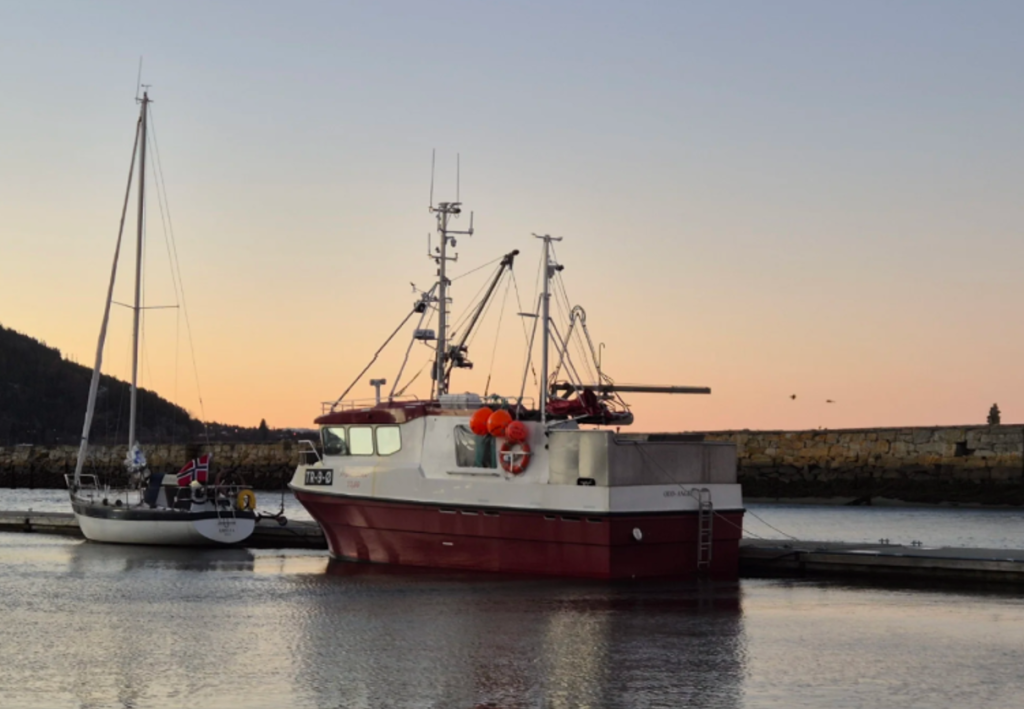
During the project’s development, several prototypes have been built to study the system’s performance. Two of these prototypes have been tested in the laboratory at SINTEF Ocean, while a third system has been installed and put into operation on the fishing vessel Odd-Angel.
The project analyses the system’s performance under different operating conditions, including variations in seawater temperature and different workloads. This monitoring makes it possible to study how the technology operates and further optimise it to facilitate its implementation in small fishing fleets.
The project’s main innovation lies in the adaptation of a CO₂ refrigeration system to the specific needs of small fishing vessels, a segment in which incorporating advanced preservation solutions has traditionally been more challenging.
From a blue economy perspective, the project demonstrates how technological innovation can be applied to a traditional maritime activity such as fishing, with the aim of improving the efficiency of marine resource use and reducing the environmental impacts associated with the preservation and logistics of fishery products.
Project Objectives
The main objective is to develop and optimise a compact CO₂ refrigeration system for small fishing vessels, improving catch preservation and reducing food losses associated with traditional systems that rely mainly on ice.
The project also aims to evaluate the system’s performance under different operating conditions and advance the development of more efficient and sustainable refrigeration solutions tailored to the needs of small fishing fleets.
Publication Date
14 October 2026