Project stakeholders
The project has been developed by a team of researchers from North Carolina State University (NC State). The research has received support from the National Science Foundation (NSF) of the United States.
Project description
This innovation project develops biomimetic structures inspired by natural marine algae formations, particularly the so-called “Neptune balls”, spherical accumulations of seagrass and other plant remains that can retain microplastics present in water. The researchers have replicated this natural principle to create materials capable of capturing plastic particles of different sizes.
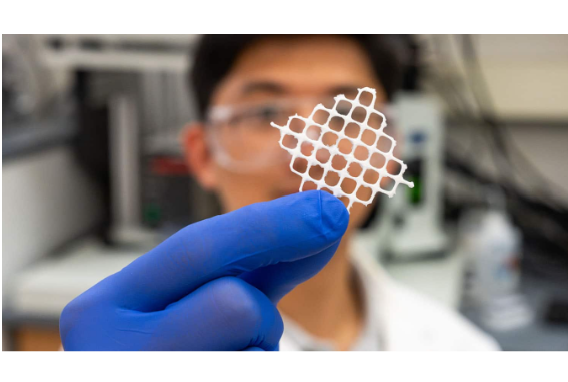
The proposal consists of porous and superadhesive meshes made from biopolymers such as alginate and chitosan, materials respectively derived from algae and crustacean shells. Their structure allows larger plastic particles to be physically retained while also adhering much smaller particles. In this way, the same material can capture microplastics across a wide range of sizes.
The main innovation lies precisely in this combination of structure and materials: instead of using a conventional mesh with a defined pore size, the structures incorporate a surface with very fine fibres that also allows the capture of very small particles. The researchers have studied the ability of these meshes to retain plastic particles in both freshwater and saltwater.
The tests carried out so far have been performed under controlled laboratory conditions and with microplastic concentrations higher than those typically found in natural waters. Therefore, there are currently no results from an offshore pilot or an application in a real aquatic environment. The research indicates that further development of these types of systems and studies on their scalability are still required.
Regarding the recovery of captured microplastics, researchers propose that loaded meshes could be collected and reprocessed. One of the possibilities studied consists of using microbial digestion to break down the microplastics and the mesh itself, obtaining biopolymeric materials again to manufacture new structures. However, this is a possibility proposed in the research and not a recovery process already validated at real scale.
The project therefore represents a research pathway within the blue economy that explores how biomimetics and natural-origin materials can contribute to the development of new tools for removing microplastics from aquatic environments.
Project objectives
The main objective is to develop biomimetic structures capable of capturing microplastics of different sizes in aquatic environments, using biopolymeric materials of natural origin.
The research also aims to advance the development of scalable microplastic capture systems and explore possible pathways for the recovery and reprocessing of the materials used in the capture process.
Publication date
17 September 2026