Project leaders
The GenDSOM project is led by Compute Maritime, a company specialising in AI-based ship design, in collaboration with Siemens Digital Industries Software, Rapid Fusion, HP, BYD Naval Architects and the University of Southampton. The project is funded by the UK Government through the UK SHORE programme of the Department for Transport, with Innovate UK as the main delivery partner for the interventions.
Project description
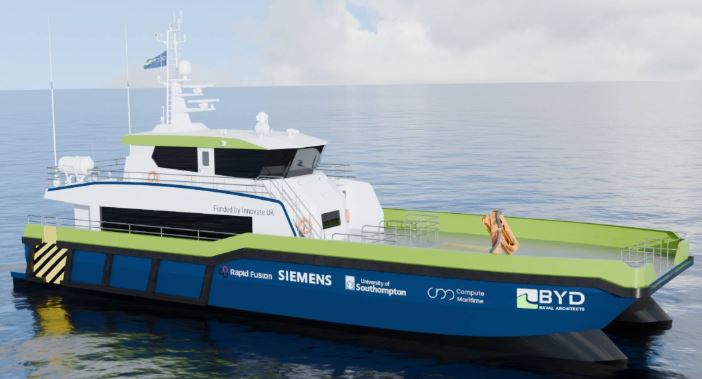
The innovative GenDSOM project has developed the first crew transfer vessel designed with artificial intelligence for the offshore sector and offshore wind farm operations. This vessel is designed to transport technical personnel and equipment to offshore installations.
The vessel is 32.5 metres in length, features a twin-hull design, and has capacity for 24 technicians and four crew members. The vessel design was developed using Compute Maritime’s NeuralShipper platform, which applies generative artificial intelligence to optimise hull form. This AI-driven optimisation reduces the power required to maintain a service speed of 25 knots by 6.3%. At higher speeds, power demand can be reduced by up to 11.6%, resulting in total annual savings of 101,671 litres of fuel and 258.7 tonnes of CO₂ per vessel.
Propulsion is a diesel-electric hybrid system developed with Siemens Energy, and the design includes an offshore fast-charging inlet, prepared to use the electrical infrastructure that offshore wind farm operators are deploying at sea. This allows the vessel to progressively transition towards fully electric operation without modifying the core propulsion system, with a projected 95% emissions reduction over its 25-year operational lifetime.
The project also includes innovation in maritime manufacturing methods through large-format additive manufacturing (LFAM, 3D printing). This additive technology prints large components layer by layer using composite and thermoplastic materials capable of withstanding demanding marine conditions.
To validate the vessel concept, a functional hydrofoil was produced using the LFAM Apollo system, demonstrating that AI-generated geometries and designs can be turned into real, production-ready marine components. This hydrofoil is a proof of concept.
Project objectives
The main objective of the project is to demonstrate that the combination of generative artificial intelligence, high-fidelity simulation, and additive manufacturing in the maritime sector can deliver real fuel and emissions savings in vessels.
Publication date
02 July 2026