Project leaders
Several leading maritime innovation companies, including Bound4Blue (Catalonia) and BAR Technologies (United Kingdom), have developed wind-assisted propulsion systems to reduce fuel consumption and CO₂ emissions in commercial vessels.
Project description
Wind-assisted propulsion technology is emerging as one of the most promising solutions to reduce the environmental impact of maritime transport. Among the most notable developments are Bound4Blue’s eSAIL® system and BAR Technologies’ WindWings®.
The eSAIL® system is a suction-based rigid sail that harnesses wind power to generate additional thrust, reducing fuel consumption by up to 40% in commercial ships. Unlike conventional sails, it combines the aerodynamic principles of rigid and rotary wing sails with a simplified mechanical design based on three main control actions—body rotation, flap positioning, and active suction—that optimize airflow around the sail. The system operates fully autonomously, requires no crew intervention, and can deliver a return on investment in under five years.
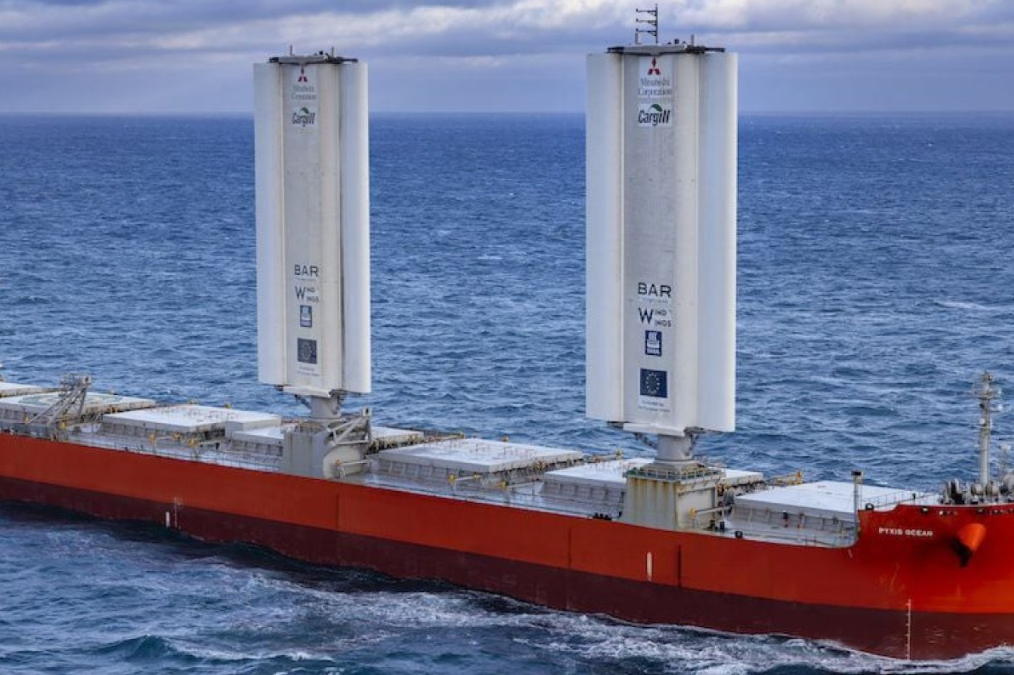
Meanwhile, WindWings®, developed by BAR Technologies in collaboration with Yara Marine Technologies, is a high-performance rigid sail system based on a patented three-element aerodynamic design capable of generating 2.5 times more lift than a single-element sail. Across global shipping routes, each WindWing® saves 1.5 tonnes of fuel and reduces 4.7 tonnes of CO₂ per day of operation.
Both technologies showcase the potential of wind-assisted propulsion to cut emissions and drive maritime decarbonization. A recent example of this innovation is the arrival of the “Pyxis Ocean” at the Port of Tarragona, the world’s first cargo ship equipped with WindWings® technology. This event marks a turning point for the adoption of wind propulsion in Mediterranean ports and highlights the growing role of ports as enablers of green innovation and the maritime energy transition.
Project objectives
The main goal of these initiatives is to reduce CO₂ emissions and fossil fuel consumption in maritime transport through the direct use of wind energy. Both Bound4Blue and BAR Technologies aim to demonstrate that wind-assisted propulsion can be efficiently integrated into existing commercial vessels, complementing other decarbonization technologies such as biofuels or green ammonia.
At the same time, these projects seek to strengthen the sustainability and competitiveness of the European maritime sector, setting new standards for energy efficiency and supporting compliance with IMO (International Maritime Organization) goals.
Publication date
October 30, 2025