Project leaders
The project is jointly led by Dutch companies Hakkers, specialized in civil engineering, and Paebbl, a technology company that transforms captured CO₂ into sustainable construction materials.
Project description
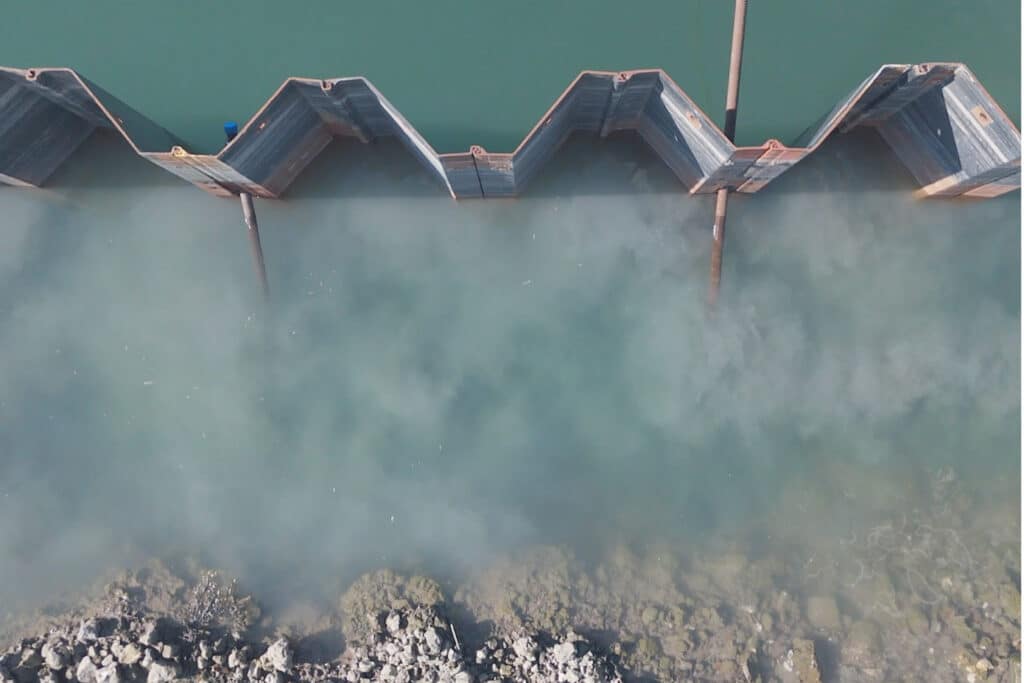
This pilot project represents the world’s first port infrastructure specifically designed to capture and store carbon dioxide (CO₂). Developed at the Port of Rotterdam, the project uses innovative materials that reduce emissions and sequester CO₂ within the construction mixes used for the anchoring of quay walls.
Specifically, approximately 15% of the traditional cement used in the anchoring of quay walls has been replaced by the developed material, which is capable of permanently fixing carbon. Thanks to this change, around 110 kg of CO₂ have been captured per ton of material used, with a total retention of about 500 kg of CO₂ in the pilot project.
In addition, fully electric drilling machinery was used to reduce direct emissions during construction, reinforcing Hakkers’ commitment to clean and emission-free works.
According to the project leaders, this advancement represents a real and scalable alternative to reduce the carbon footprint in civil engineering projects, a sector in which cement is responsible for nearly 8% of global CO₂ emissions. The company accelerates the natural carbon mineralization process a million times, turning it into a stable mineral and preventing it from reaching the atmosphere.
Project Objectives
The main objective is to demonstrate the technical feasibility of this new material that captures CO₂ as a partial substitute for cement in port infrastructures. The project also seeks to promote a paradigm shift: transforming ports and transport infrastructures into active players in the fight against climate change, turning them into carbon sinks.
This pilot opens the door to a new generation of civil works that directly contribute to the climate neutrality of the construction sector.
Publication date
October 3rd, 2025